📦 FREE shipping on orders over $30!
USA

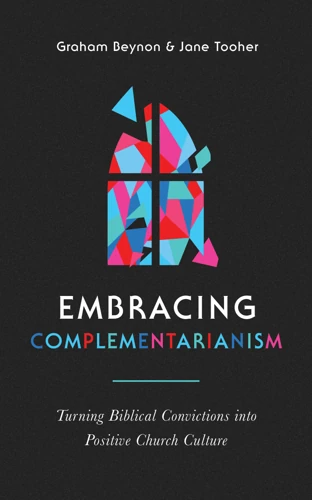
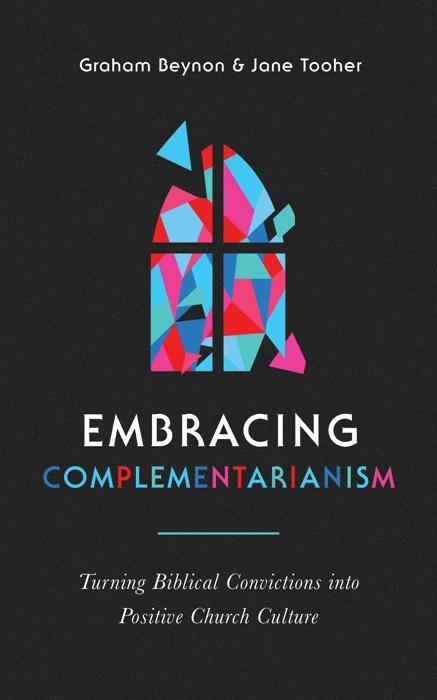
Embracing Complementarianism

Turning Biblical Convictions into Positive Church Culture

4.50 stars  from 6 reviews
$15.29 $17.99 15% OFF

Free Shipping on U.S. orders over $30

Bulk Deals

10+ copies 30% off $12.60 each
25+ copies 40% off $10.80 each
50+ copies 50% off $9.00 each

Discounts applied automatically in your basket.

Free eBook included with the paperback

When you make the purchase, links to your ebook files (EPUB, MOBI and PDF) will be emailed to you immediately. We will ship the paperback to the shipping address given.

About this book

It can be tempting to shy away from addressing the issue of gender roles in church because it’s often controversial. But this can result in churches either being increasingly influenced by secular culture or simply sticking with the status quo when it comes to what men and women do in church.

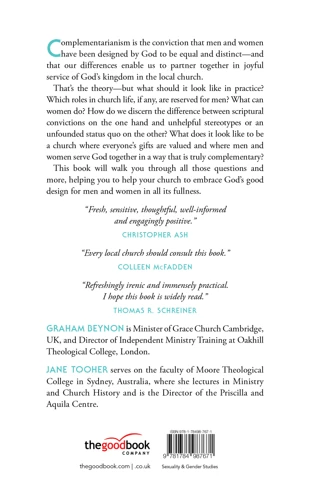
Building on the belief that complementarianism is both biblical and positive, this book focuses on what these convictions look like in practice. Moving beyond the familiar discussions around "gender roles," and leaving room for variety in how readers implement these ideas, it will encourage a church culture where men and women truly partner together—embracing their privileges and responsibilities, and maximizing their gifts, in joyful service of God’s kingdom.

Read more

Specifications

Contributors:
Graham Beynon, Jane Tooher
ISBN:
9781784987671
Format:
Paperback
First published:
October 2022
Dimensions:
5.3" x 8.5" x 0.6"
Weight:
7.20 oz
Print size:
11.0pt
Case quantity:
30
Language:
English
Pages:
160
Publisher:
The Good Book Company

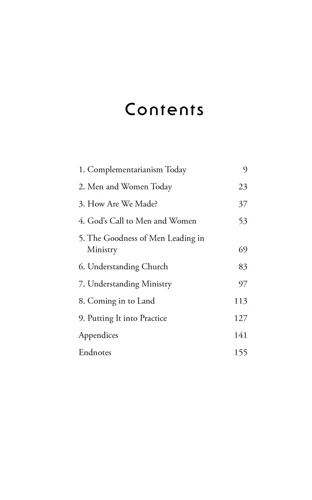
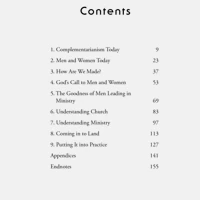
Contents

1. Complementarianism Today
2. Men and Women Today
3. How Are We Made?
4. God's Call to Men and Women
5. The Goodness of Men Leading in Ministry
6. Understanding Ministry
7. Understanding Church
8. Coming in to Land
9. Putting It into Practice
Appendices

Endorsements

In a day when polemics are often wielded on both the right and the left, it is refreshing to read an irenic and immensely practical book on what it means to embrace complementarianism. Beynon and Tooher’s book will help pastors and church leaders (and laypeople too!) to think carefully about what it means to include both men and women in the ministry of the church in a complementarian framework. I hope this book will be read widely and will lead to further clarity, understanding and humility as we work out what it means for both men and women to be involved in the ministry of the church.

Thomas R. Schreiner Southern Baptist Theological Seminary

Here’s a book for those looking for sound reasoning and humble guidance in regard to the practical application of complementarity in a variety of church contexts. Graham and Jane graciously and consistently apply what the Scriptures teach with a lack of rigidity yet with firm conviction in regard to the biblical call for men and women to express their godliness through gender.

Nancy Guthrie Bible teacher and author of the Seeing Jesus in the Old Testament series

I much enjoyed reading this fresh, sensitive, thoughtful, well-informed and engagingly positive treatment of what is so often seen as just a troublesome and controversial topic. The authors leave space for readers to come to different conclusions in detail, under the shelter of a glad affirmation of the goodness of the word of God in every passage of Scripture. I especially valued the tone of gentle gladness allied to a confident affirmation of essentials.

Christopher Ash Writer-in-Residence, Tyndale House, Cambridge.

This helpful book will challenge you to think through the implications of your complementarian convictions and then put them into practice at your church. Every local church should consult it.

Colleen J. McFadden Director of Women's Workshops, Charles Simeon Trust

This is a book I have been waiting for! Graham Beynon and Jane Tooher have done a beautiful job in explaining what complementarianism is (and isn’t!), showing how it is rooted in the Bible and describing what it might look like in action. This gracious introduction to a controversial and potentially divisive issue is eirenic, thoughtful and stimulating. I think this will be so helpful in all kinds of contexts as together we work out what biblical faithfulness looks like in the life of the local church and beyond.

Gary Millar Principal, Queensland Theological College, Australia; author of Saving Eutychus

Writing a book on complementarianism today is like lighting a match in the dry forest of Western society. It can ignite a raging controversy in a culture deeply conflicted about gender. But Jane Tooher and Graham Beynon commend complementarianism in a clear, and compelling way. Their book is biblically rich and wisely applied for God’s people as his beautiful design.

Richard Chin National Director, Australian Fellowship of Evangelical Students, Sydney, Australia

This outstanding book is deeply grounded in the Bible, shows a clear grasp of the contexts in which our churches are working, and is thoroughly readable and highly stimulating. It will help you rethink your convictions. It will encourage you to value highly the ministries of women and men. It will challenge you to work out together what you believe about women’s ministry in the life of the church. It will provide excellent pathways towards implementation of positive complementary ministry.

William Taylor Rector, St Helen’s Church, Bishopsgate

This is a brilliant book to help church leadership teams think through how they implement complementarian convictions. The authors are enormously sympathetic to the wide variety of personal and church experiences which readers will bring to these questions. They helpfully challenge whether complementarian churches actually embody equality and whether they manifest a genuine feel of family, rather than just asserting those things. Whatever your personal convictions on the relevant biblical texts, Graham and Jane ask really helpful questions to make sure that these convictions are lived out in a manner which produces a mutual flourishing of the sexes.

Matt Fuller Senior Pastor of Christ Church Mayfair, London; author of Reclaiming Masculinity

A really useful book. It clearly explains the various positions on complementarianism and the potential imbalances that each is prone to. You will be equipped to examine and understand your own position and to embrace it with clarity, conviction and joy.

Jennie Pollock Writer and editor

Those of us who believe the Bible teaches distinct roles for men and women in church cannot presume to commend our view on the strength of our exegesis alone. We need urgently to show not only that it is true but that it is good. We need to be able to point to healthy local churches and ministries and say, ‘There! Like that! That’s how it’s done well.’ Tooher and Beynon have written a book that speaks directly and compellingly to this need. It’s a book that moves beyond the ‘what’ to the ‘how.’ Both authors have extensive ministry experience, which shines through in their writing. They understand that for most of us, the challenge is not so much what the Bible says but how to land it faithfully and fruitfully in the actual circumstances of mission and ministry in the 21st century.

Rory Shiner Senior Pastor, Providence City Church, Perth, Australia

We always need to teach the truth about what the Lord says, confident that it will be a blessing. This fine book gives us the courage to see that the complementarian position is good for us as we experience what it is like to belong to the family of God. It shows that as we truly model family in the church, we will be witnessing to the world around us about the transforming power of the gospel. Read it and see.

Peter Jensen Archbishop of Sydney

There are many superb books on the theology of complementarianism, but this one is different! It gives complementarianism ‘legs’ and probes what it could look like on the ground in your local church. The emphasis is on exploring ways for men and women to minister together rather than settling for the status quo. I’ve worked at the coalface of complementarianism for 30 years, but my intuition tells me that this book has the potential to transform the complementary ministry of men and women for a new generation.

Lesley Ramsay Evangelist; Trainer; Bible Teacher

Embracing Complementarianism paints an engaging and persuasive picture of what complementarianism might look like in the local church. It is neither dismissive of alternative views nor prescriptive of the conclusions reached by the authors. Rather, it raises some vitally important questions about men and women serving together in ministry, and encourages pastors and churches to reflect deeply on their convictions about Scripture’s teaching in this area, and the way they are, or are not, put into practice. It’s a book to make use of, not merely to read and keep on the shelf. This is the book on complementarianism we’ve been waiting for!

Kanishka Raffel Dean, St Andrews Cathedral, Sydney Australia

The abuse of power by some prominent church leaders in recent years has left many in our constituency wondering if the complementarian position is as toxic as many of our opponents would suggest. Certainly, those who define complementarianism purely on the basis of what women cannot do are shooting themselves in the foot and exposing their ignorance. So, what does it mean to be complementarian, and how can we be sure that our biblical convictions are having a positive rather than a negative impact on our church culture? In this book, Graham and Jane are not just asking us to consider the biblical principles but actually show us (and model for us) what it means to embrace them and live by them. If we believe that God’s design for men and women is for our good, then embracing it is not an optional extra for Christians but absolutely key if our families and churches are to flourish.

Carrie Sandom Director of Women's Ministry, The Proclamation Trust

Here is a fresh and envisioning guide to help church leaders move beyond an embarrassed defence of complementarianism to advancing a positive vision of men and women working together in a local church.

Paul Rees Senior Pastor at Charlotte Chapel, Edinburgh

Few issues have generated more controversy in our culture and the church in recent years than the relationship between men and women. Complementarian theology has been condemned by some as abusive, and its advocates have all too often taken a defensive approach. Drawing on their many years of church ministry and training experience in Britain and Australia, the authors present a compelling, positive vision for complementarianism that rejects outdated stereotypes in favour of a holistic biblical vision of God’s creational plan for men and women. Irenic in tone, culturally sensitive and exegetically rooted, this book will help reluctant complementarians to more joyfully embrace what they believe. Egalitarians evangelicals who read it will gain a better understanding of the convictions and concerns of complementarian brothers and sisters. It unpacks the practical implications of complementarianism for church life without being prescriptive and provides helpful reflection questions for individuals and groups.

John Stevens National Director, Fellowship of Independent Evangelical Churches, UK

Customer Reviews

4.00 stars Helpful and humble

  Reviewer Program Member

This is a helpful book to thoughtfully consider how to put into practice the Biblical conviction of complementarianism. Without telling the readers exactly what to do, the authors give clear Scripture support and application for how men and women should work alongside each other in ministry. They graciously cover a sensitive topic with an outpouring of Scripture and an obvious humility. Each chapter ends with reflective questions and group questions to dig in further. This would be a great book for church leaders to read and discuss together as they carefully consider how to put complementarianism into practice in a ...

Continue Reading

5.00 stars Great


(Review written for 'Embracing Complementarianism (ebook)')

Love opening w positivity

5.00 stars A Great Introduction to a Big Topic


Having seen myself as potentially a complementarian but without really thinking a huge amount about the theological arguments for each theological interpretation, this was a really helpful introduction to the subject before reading some more detailed, academic volumes.
The authors set out a clear scriptural case for complementarianism and, unlike many books on the topic that I've read recently, they also move from the theological discussion to a good wrestle with the application, particularly in the areas of church leadership, preaching, staff teams and similar areas of common questions. This will be really useful to think through with our staff ...

Continue Reading

Write a Review