| 10+ copies | 30% off | $8.40 each |
| 25+ copies | 40% off | $7.20 each |
| 50+ copies | 50% off | $6.00 each |
Discounts applied automatically in your basket.
When you make the purchase, links to your ebook files (EPUB, MOBI and PDF) will be emailed to you immediately. We will ship the paperback to the shipping address given.
You aim to be intentional and faithful in all areas of life, and AI is now part of life. So what does it mean to think biblically about AI and the way it affects your day-to-day? What sorts of problems can AI help you with? What impact might it have on your church?
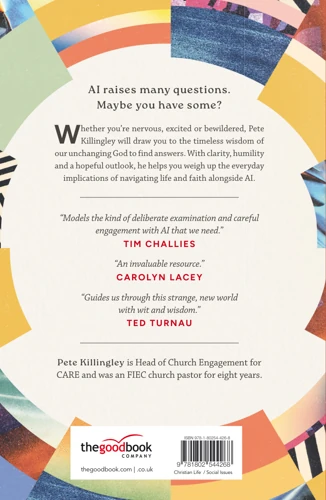
Whether you’re nervous or excited about technological changes, Pete Killingley’s guide to AI for Christians walks through basic concepts and common questions. With precision, clarity and humility, he’ll show you how insights from God’s word can inform your perspective on technology. No technical experience is required.
Consider the real-life implications of answers to questions like…
In a world of fast-changing technology, this book shows how our unchanging God can help us to think about AI in a godly way, through his Spirit and by his word.
*This book and its description were not formulated by AI. Their authorship is 100% human. You can find our AI policy here.
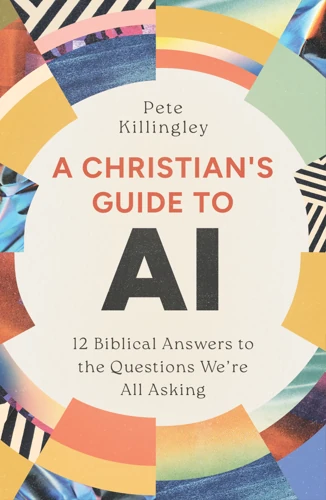
In A Christian’s Guide to AI, Pete Killingley provides 12 biblical answers to the questions we’re all asking. This is a timely and accessible guide, and a great place to start for anyone who wants to think seriously about how artificial intelligence is shaping our world and what it means for our faith.
What I most appreciated about this book is that Killingley is not afraid to ask the hard questions. He tackles concerns that many of us are already ...wrestling with, including, “What should I do if AI takes my job?” and “Do I need to fear the future with AI?” Rather than avoiding the uncertainty surrounding AI, he brings these questions into conversation with Scripture and provides thoughtful, biblical answers.
Biblical and Balanced
Killingley also addresses questions specifically related to faith and the Christian life. Questions such as, “Should I Use AI to Help Me Write My Bible Talk?” and “Evangelism: Can AI Help Us Share the Gospel?” are particularly helpful for believers and church leaders who are trying to navigate how AI should—and should not—be used in ministry.
With biblical grounding, balanced answers, and practical application, A Christian’s Guide to AI provides a helpful framework for approaching this rapidly changing technology with wisdom.
I received a media copy of A Christian’s Guide to AI and this is my honest review. @diveindigdeep
I approached this book sceptically, wondering what more is there was to say about the pros and cons of AI, given how prominently and frequently they have been debated. But from the first page, my assumptions were overturned. Instead I learned that there is so much more to AI than I was aware of. Even more significantly, Pete Killingley offered a biblical perspective which was both cautionary and constructive and full of godly wisdom. I would commend this book to anybody.
With reassuring transparency, Pete Killingley begins the introduction to this timely, readable, well-researched book with the following assertion:
ChatGPT did not write this book.
AI was used, however, ‘at many points in the process’. Therein lies the dilemma for a writer. How much help, of whatever sort, renders the work no longer your own? At which point does another’s input ...make a fraud of a writer who puts his name to a text? And if that other is an LLM, how can we be sure that what we read today is the creative work of a human being made in the image of God and not the generated text of what Killingley calls ‘apparent intelligence.’?
These questions burn in the minds of any artist but are also relevant for everyone, whether or not they consider themselves a ‘creative’.
Whatever our feelings about AI as individuals, we have an interest in the church’s stance on this fast-moving, emergent reality. Killingley pertinently suggests that the church can either put itself at the ‘forefront of the change’ or leave itself ‘picking up the pieces of the people AI leaves in its wake’ and although the Bible does not refer to AI explicitly it has much to say on the subjects it permeates: work, humanity, technology and creativity; relationships, learning, formation and the Bible to name a few.
Highly recommended.