“The god of this age has blinded the minds of unbelievers, so that they cannot see the light of the gospel of the glory of Christ” (2 Corinthians 4 v 4).... continue reading
The question in the office/at the schoolgate/in the pub comes: Do you really believe in a God who told Israel to wipe out the Canaanites?
And you take a deep breath, offer up a silent and very heartfelt prayer, and open you mouth…

Welcome to a new Good Book Blog competition. Every quarter there'll be a winner, and the prize will be a year's free subscription to Explore, our daily Bible-reading notes.
How do you win? Just send us a picture of you with Explore in a wonderfully exotic or hilariously imaginative situation. The most farflung or funny entry will be announced on the blog as the winner, with the first victor being unveiled a couple of weeks before Christmas.
So, if you're heading somewhere on holiday soon, take a snap of yourself doing your Explore study and email it to: explorecompetition@thegoodbook.co.uk
And if you're going no further than your workplace or the school gate in the next couple of months, don't despair! Get your creative juices flowing and send in a picture of yourself reading Explore in a place no one has ever thought of reading it before…
And if you're not an Explore reader, but fancy taking part (and getting stuck into God's word each day to be encouraged and equipped to love and live for Him), you can grab the latest issue here.
PS By the way, if you use Engage Bible study notes, then you can take part in this comp in just the same way, using Engage instead of Explore.

Which “side” do you take over the Dale Farm evictions?
Is it Christian to insist that the law is applied, that people are treated fairly and so punished when they break it, that lawbreakers shouldn’t get ahead of lawkeepers? Or is it Christian to ask for compassion on the travellers, who are staying true to their own culture and way of life, and who have built their lives on that site and in that area?
Watching the struggle on the news, and the evictions that were inevitable once the bailiffs had moved in, brings to life the shock of the parable of the tenants (or maybe we should call it the parable of the eviction) Jesus told in Mark 12 v 1-12.
And it brings home the shock that the tenants facing eviction are us.
Ultimately, we’re all illegal squatters, living in a world that isn’t ours but refusing to pay our dues to the owner. And we’re all facing certain eviction.
So far, so “kick out the travellers”.
But there’s a greater shock in Jesus’ parable even than the forcible eviction and death of the tenants. “He will … give the vineyard to others” (v 9). Who are the “others” who are given the world to live in? Not the deserving, but the undeserving. Not those who never kicked out the landlord’s son, but those who realized their mistake and asked for forgiveness.
That’s grace. That’s like Essex Council winning all the legal battles, proving the land was theirs and the travellers had no right to be there, preparing the bailiffs to move in with overwhelming force… and then walking in with the deeds to the land and saying to those living there illegally: “Here you are. It’s yours”.
I’m torn between the impulse for the law to have its say and be applied, and for compassion to be extended to the travellers. And I think that’s probably the Christian way to look at it. God is a God of total, unremitting justice; He’s also a God of amazing, undeserving grace. It’s right for us to long for justice; it’s right for us to long for grace; it’s wonderful that in Jesus Christ, the Son who was evicted in our place, we find both justice and grace.

Main point: Everyday evangelism is a job for everyone, not just for “professionals”
Evangelism is an intrinsic part of any healthy church. It’s part of gospel community. It shapes our gospel teaching. And perhaps it’s helpful to outline two potential approaches to evangelism a gospel-centered church can have: frog-centered, and lizard-centered.
Frogs are very good at catching flies with their long tongues. They stay on their lily pad, waiting for that fly to come close.
Lizards are not so good at catching flies. But they move around. They see more flies, and some they catch.
There may be a lot of biology-related holes in this analogy (if there are, blame the Lausanne Conference for World Evangelisation 1989—that seems to be where it was first used). But it’s a helpful way of thinking about evangelism (hopefully you won’t mind being described as a “frog” or a “lizard”!).
Could it be that often we (consciously or subconsciously) think of evangelism as a job for the pros, the people who work for the church? They’re great at explaining and defending the gospel—they have long tongues!
Problem is, the pros don’t get around that much. They’re not in the workplaces; not at the school gates; not in the sports clubs. That’s where the lizards, the ordinary church members, are. They come into contact with a lot more flies (non-Christians) than the professionals.
Every day, the church membership can be seeking to evangelise far, far more people than the church leadership ever can—particularly in a time when cultural reasons for contact with church leaders, such as baptisms and weddings, are fading.
So why don’t we? Maybe it’s because evangelism is seen as too hard, or too complicated. Or because we’ve tried it and “failed”. Or because we’ve simply never been challenged to do it. The obstacle to every-member evangelism will vary from church to church.
But the key is to empower and equip the lizards to go fly-hunting. A few ideas:
Practical suggestion: Ask yourself, or others, what stops them sharing the gospel. Then think about whole-church solutions to those obstacles.
Main point: Church is a place to be deliberately family-focussed and outsider friendly, at the same time.
Church is a family. Jesus Himself said “My mother and brothers are those who hear God’s word and put it into practice” (Luke 8 v 21).
But it’s an open family. Anyone can join, by receiving Jesus as Lord (John 1 v 12-13). And it’s a welcoming family. At the family get-togethers, what the family does is meant to attract outsiders (1 Corinthians 14 v 23-25).
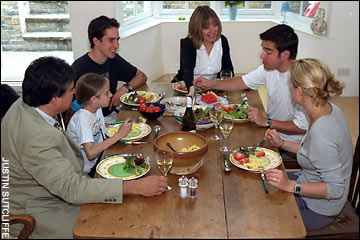
Imagine the scene. It’s a suburban house, and the family are sitting down to their meal. Nothing special in that; but tonight is different. Johnny, the son, has brought his girlfriend, Sarah, round. It’s the first time his parents have met her—and the first time she’s met them.
How will the presence of Sarah make a difference? Well, in one sense, she won’t. The family is still the family, and she’s not part of it (yet—Johnny’s hopeful, though!). They still sit down at their dining table for food, at the normal time, in their normal places, eating food they like.
But in another sense, things are very different. Mum checked what food Sarah liked beforehand. Everyone introduced themselves to her. Dad made sure Sarah was included in the conversation. Her opinion was asked for and listened to.
Is this a helpful way to think about how our church gatherings should be? It’s a family occasion—with non-family members there. The family need feeding, but that never needs to be at the expense of being welcoming and accessible to non-Christians, listening to them and being relevant for them.
This isn’t an “either-or” (either church is for Christians, apart from the odd evangelistic service, or it’s a seeker service, for non-Christians, with nothing for mature believers). It’s a both-and (both for Christians and for newcomers).
I wonder if the way to tell if a church is both-and is this: Would church members confidently bring a non-Christian friend on any Sunday, and know that they’ll be welcomed, feel listened to, and hear the gospel relevantly?
What might help the answer to that question be “yes”? A few suggestions:
If Sarah chooses not to become part of the family, we want that to be because she decides she doesn’t love Johnny, not because his family put her off before she had a chance to work out how she felt about him! If a newcomer decides not to become part of our church family, let that be because they decide they don’t love the Lord Jesus—not because Jesus’ family put them off before they had the chance to work it out!
Practical suggestion: At your next Sunday service, try to put yourself in the shoes of someone who’s never been to church before. What would help you understand what was going on, feel included, and not awkward? What would help you feel valued and worthwhile, and as if you matter?