Christians should get angry. But we need to get angry about the right things.
We’re currently developing a Good Book Guide for small-group Bible studies looking at the book of Jonah.
The author’s Stephen Witmer, a pastor in Massachusetts. And he makes a great comparison between Jonah, and what makes him angry, and Jesus, and what makes him angry.
Stephen’s put loads of interesting, challenging stuff like that in the Good Book Guide. It should be out this summer.

Half of elite scientists are “religious”, and another fifth consider themselves “spiritual”, according to a recent study.
The US survey, which is based on 1,700 scientists, suggests that Richard Dawkins’ famous claim that elite scientists are atheists is also a rather false claim.
That’s the first interesting point made in an article about the study in today’s Guardian.And Nick Spencer goes on to make a couple more really thought-provoking observations:
“Our conviction that scientists, elite or otherwise, are somehow better qualified to discern the nature of reality is dubious.
“Elite scientists undoubtedly know vastly more about their subject than other people. But to imagine that that makes them somehow better qualified to adjudicate on big-picture questions is like saying because I know my home town like the back of my hand, I am well-equipped to lecture on European geography.”
“Christ often remarked on the inability of the educated elite of his time to get what he was about.
“There is a long-standing theme within Christian thought that sees the Christian message as having a particular appeal to the underclass, not only those socially and politically alienated, but also those the intellectually and educationally excluded.”
My question is: is that true of Bible-teaching churches today in the UK? Does the way we run our churches, and the style of our teaching, have “a particular appeal to the underclass”, both in social and educational terms? Or does it tend to have more of a “particular appeal” to middle-class, university-educated “elites”?
What do you think?

I know, I know, Christmas is well and truly over, and no-one wants to think about it till next November at the earliest (apart from super-organised people who are picking up discounted Christmas cards and decorations for next year).
But in publishing, we have to think ahead (not something I'm known for): and we're starting to develop a short evangelistic book which uses the historical events of the first Christmas to explain the gospel. It's for giving to friends, handing out at carol services, and so on.
Here's my current question: How do you get to the cross and resurrection from the Christmas story?
Obviously, no gospel explanation is complete if it includes only the manger, and not the cross and the tomb. But how to get there without a horrific, crunching gear change?
That's where I'd love your help! If at Christmas-time you've ever chatted to friends, family or colleagues who don't know Christ, how did you get to the cross? How have you heard others do it? How would you like it to be done in a book you could happily give to those contacts?
All ideas very gratefully received! Post a comment below. And then get the book next Christmas to see how we did it…
Here's something truly encouraging.
It's an article in Evangelicals Now, a simple testimony of one man's path to faith. But the really heartwarming thing is the number of different individuals involved, and how God guided this guy's questioning over a number of years.
He was struck both by what Christians said, and also how they lived – from school years onwards.
I would guess that some of those involved never knew whether their words and actions had an impact – maybe they thought he was yet another person they prayed for but who didn’t respond.
It's just really encouraged me to keep reaching out, even though most of the time I won’t know if there’s any fruit until the new creation.
Leading our church service last Sunday, I remarked that church was like a lot of different things:
It was a throwaway line to introduce the confession we said together but, in a way I hadn't planned or foreseen, its real value came after the meeting as we mingled for coffee.
I find it quite awkward sometimes to open up conversations with people at a level deeper than "How was your week?" I usually find myself talking about the kids rather than about Christ.
But on Sunday, I just asked people this simple question: "What did you need most this morning - a school, a family or a hospital?"
It opened up a series of brilliant conversations about the sermon, our human needs, and about some doubts and other issues people were concerned about. It felt like fellowship ought to. Real, natural, open, non-judgmental and caring.
Why not try it this Sunday morning... and why not help me for next time I lead a service, by leaving a comment suggesting another way to prompt some Christ-centred post-church conversations?

A recent study by the UK Department of Education has discovered the top ten factors in having happy children. Some surprises, but a lot of great encouragement for parents. Here's the list:
So worth persevering with family meal times, keeping the lines of communication open and insisting on brocolli.
But you might also check out Luke 6 v 20-23 for some challenging thoughts on how your children will be truly happy... it's Jesus' list. I suppose the rather glaring difference between the two springs from the fact that Jesus' factors are taking eternity into account, rather than focusing only on the here and now.

Jesus is everywhere in the Old Testament: He said so Himself (in Luke 24 v 27).
There are the famous bits, like Psalm 22 and Isaiah 53 and the Passover in Exodus 12-13. But recently I've been reading through 2 Samuel, mainly because I'm not sure I've ever read through it from start to finish before. And in 2 Samuel 15, God's chosen king David faces a rebellion. His own son has set himself up as king in his place; Israel has rejected him. He's been betrayed by a trusted companion, Ahithophel. He has to flee Jerusalem, passing through the Mount of Olives as he does so. Those who see him weep.
It looks as though all is lost: God's christ, David, has lost God's kingdom.
But outside Jerusalem, David wins a great victory, and is restored to the throne.
It should be a happy ending, but it isn't. His rebellious son, Absalom, is killed, and David mourns for him: “My son Absolom! If only I had died instead of you!” (2 Samuel 18 v 33).
David's kingship is secured, but his rebellious son could not be saved.
I was happily reading through this historical account (I'm a history geek) when the penny dropped: what happened to God's "christ" David is a glimpse of what would happen a millennium later to God's ultimate Christ, Jesus.
But Jesus could do what David only wished he could: save His rebellious people, by dying instead of them. On Jesus' lips, David's “If only I had died instead of you” became “This is my body, given for you” (Luke 22 v 19).
Jesus both secured his kingship and saved his rebellious children.
That's our King. Isn't He amazing?
Jesus in 2 Samuel. Wow.
If you've come across Jesus in the Old Testament recently, do share it below so we can all say “Wow” (or, in more theological language, “Alleluia”).
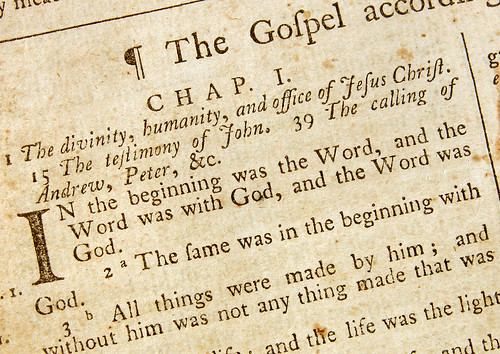
Stop press: the Bible encourages us to have sex outside marriage.
Or at least one Bible translation did—the so-called "Wicked Bible", a 1631 edition of the King James Version which managed to miss the word "not" out of the seventh commandments.
It's going on display, along with a lot of other very old (and much more correct!) Bibles, at Cambridge University.
Got me thinking: first, were there any happily-married 17th-century readers who immediately ran out of the house to obey the command?!
And second, what Bible verse today do we most often act as though it said something very different? Mine would probably be replacing the word "pure" with "zero" in James 1 v 2.
There were a hundred people on the platform, and only about 20 spaces left on the train. So there I was jostling with everyone else, trying to get through the doors before they shut. I even managed to dodge in front of a woman who'd been queuing in front of me. I was going to make it!
Then, for some unknown reason (actually, it was probably the Holy Spirit), these words popped into my head:
“Whoever wants to become great among you must be your servant, and whoever wants to be first must be slave of all. For even the Son of Man did not come to be served, but to serve” (Mark 10 v 44-45).
I was trying to get myself to a position higher (nearer the doors) than I deserved by my queuing. Jesus would not only have not done that, he would have have got himself to a position lower, further away from the doors, than He deserved.That's what greatness looks like in His kingdom.
Occasionally I make some big, obvious act of service (usually in church, usually where people can see). But how often have I jostled on the platform? How regularly do I miss the opportunity, in all sorts of circumstances, to become a “slave of all”, and do what's best for others and not for me?
So, next time the signals are down and there's a mass scramble for the train, I'm going to try to let those words of Christ affect my behaviour. Even train queues are a chance to be Christlike.
I must be missing loads of others. All suggestions for other situations welcome – comment below!

The hole in the bag of muesli spilled a small pile of grain to the floor. A small collection of random fluff and objects is found gathered into a nest behind the sofa. Our worst fears are realised. Mickey's come to town.
After much searching, the mousetrap is finally found and set (with chocolate as the bait). We bed down for the night to wait what the morning will bring. It brings a tiny corpse, a problem solved, but also some conflicting emotions.
I know they are filthy and unhygenic. But as I stare at Jerry in the trap, I am overwhelmed by just how beautiful he looks. No other word to describe. Even in his squashed and lifeless state, the eyes shine, the feet are tiny works of perfection, the glossy nose and the feathery whiskers are a miracle of design and construction. I mourn for this glorious piece of God's handiwork that I had squished the life out of, for the sake of homeland security.
"Don't show it to me" says the beloved. "it was only trying to get along and to live". (She was the one who'd ordered the execution, but it wasn't the moment to mention that.) Daughters variously fascinated, appalled, bemused.
As the dog sniffs interestedly, and not-so-speedy Gonzales is placed in a crumpled Sainsbury's bag and committed to the deep of the dustbin, I wonder at the value of my own life and its passing.
“All people are like grass, and all their glory is like the flowers of the field; the grass withers and the flowers fall...” says Peter.
I am nothing, small as a mouse when compared to the span of history and the breadth of the cosmos: and yet, and yet:
... but the word of the Lord endures forever.” And this is the word that was preached to you.
Through the Gospel message I can endure forever. Humbled. Inspired.