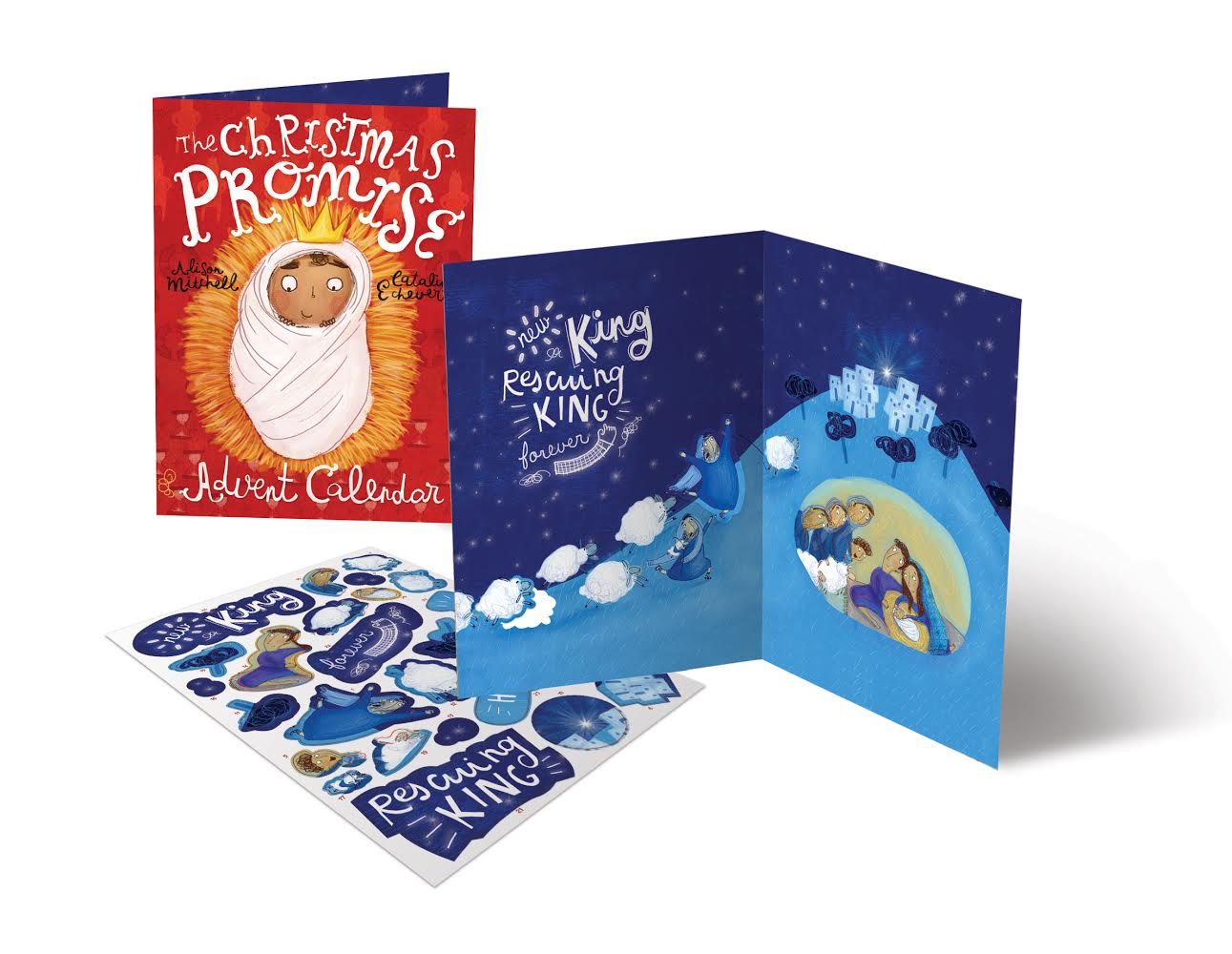
What do you get if you combine two of a child's favourite things - stickers and Christmas? The answer is The Christmas Promise Advent Calendar. This A3 calendar features a stunning full-colour scene by Catalina Echeverri, but with lots of the elements missing.
Each day there's a sticker to add to build up the scene until Christmas Day, when the baby Jesus is placed in the manger. But this calendar makes it clear that Jesus isn't just a cute baby. The story on the back shows how Jesus is the King God promised to send his people - a NEW King; a RESCUER King; a FOREVER King!
The Advent Calendar can be used on its own, or alongside the new children's storybook, The Christmas Promise.
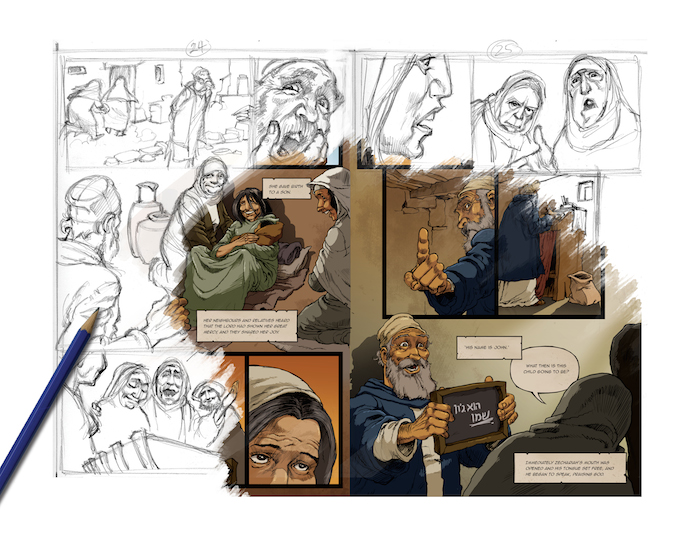
And here's one more peak at our latest graphic novel, Light in the Darkness.
Using the words of Luke, and the images of talented illustrator, Alex Webb-Peploe, Light in the Darkness brings the Christmas story to life.
Pre-order HERE.
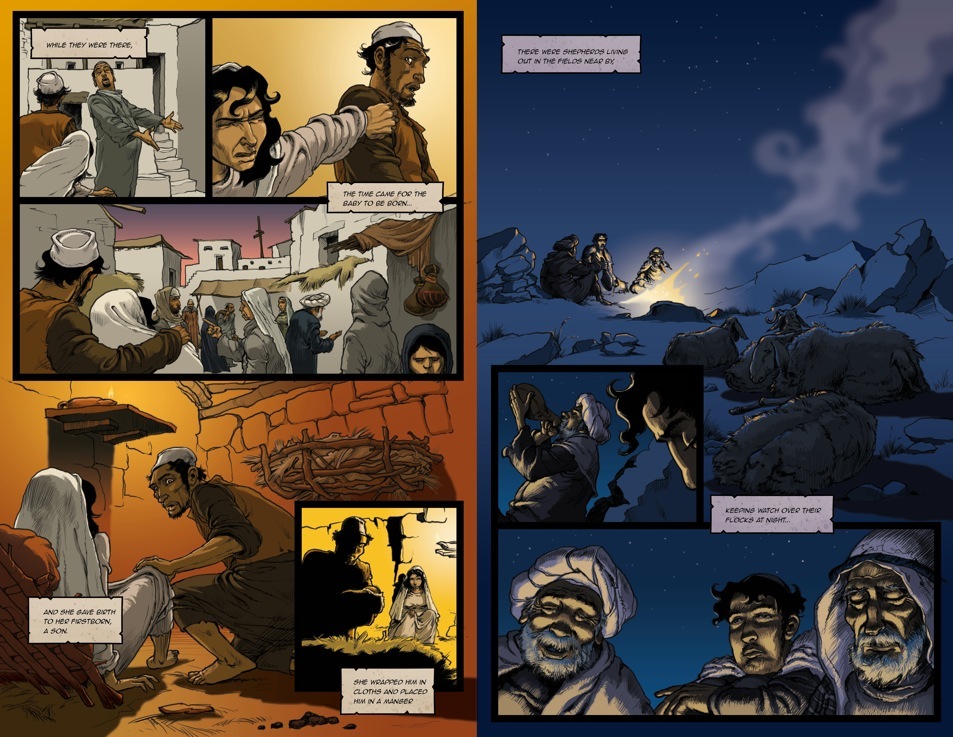
Here's a sneak preview of our great new graphic novel, Light in the Darkness. To pre-order your copy, click this link: Light in the Darkness
"Christmas is just for children."
You often hear this said by bored teenagers and adults as they move beyond the Disney-fied storybook versions of the first Christmas that fill our bookshops at this time of year.
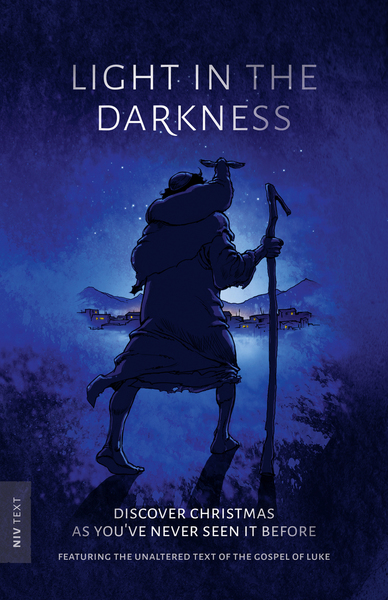
But of course it is not. Each year we apply ourselves as a creative team to thinking how we can keep the Christmas story fresh for those beyond the childhood years. This year we have been thrilled as we have worked on the "prequel" to The Third Day - our graphic-novel style realisation of Luke 22-24.
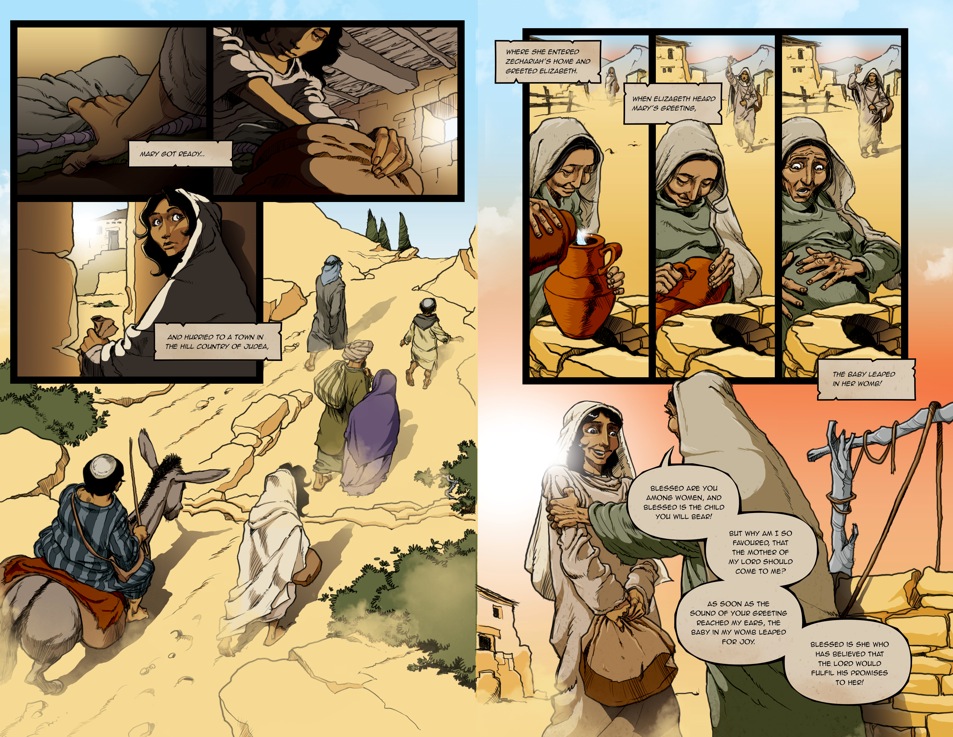
Light in the Darkness has the same gritty, contemporary feel that is so far removed from the graphic versions of the Bible already available. This resource will introduce the biblical account of the first Christmas to a new audience in a fresh way, powerfully capturing the joy, pain and emotion of Luke 1 and 2.
The depths of what Luke records for us in these chapters has come across to us in a powerful way as we have thought our way through them, working out how to illustrate them. The pain of childlessness for Elizabeth and Zechariah; the bewilderment and confusion over the angelic messages; the joy and happiness over the children; and the theologically rich songs that are sung throughout.
We're just putting the final brushstrokes to the colour but look out for this stunning new resource when it appears in early November.
This is an extract from the recently published Engaging with Hindus.
I was born in India but when I was eighteen, I went to Kenya to be married. In 1966 the whole family left Kenya and came to Britain. We found it very difficult coming to a strange country and adjusting to the different lifestyle.
I was a practising Hindu but was finding that Hinduism did not satisfy me. I started searching for an answer to my difficulties. One day I shouted out to God: “Please come and help me”.
Shortly afterwards, a friend suggested I try the Radha Soamis (a popular spiritual path led by Gurinder Singh Dhillon). My whole family went to their headquarters at Beas in the Indian Punjab. I took an oath not to eat meat or eggs. The Master gave me a mantra on which to meditate. I repeated it daily for two and a half hours but still didn’t have peace and security. Then I began to think: “I became a Radha Soami to receive peace. If I haven’t got it, I have been cheated.” I asked God: “I do all the correct things. Why haven’t I got peace?”... continue reading
This is an extract from the recently published Engaging with Hindus.
What is our aim as we engage further with our Hindu friends? Is it to find common ground and ways of living together in our divided society? Is it to persuade them to change their religion and be converted? Here are some suggested goals:
To seek to know the true and living God along with our Hindu friends which includes respecting their search for God and sharing with them our experience of God, so that they will also experience God’s love, grace, peace, forgiveness and justice shown to us all in the Lord Jesus Christ.
This combination of receiving (learning about, and respecting their search for God) and giving (sharing what we have experienced) reflects the example of Jesus himself. He condemned false religion, pride and selfishness. But he commended the faith of outsiders like Roman soldiers and Gentile women as they were drawn to him (see Matthew 8 v 5-13; 15 v 21-28). At the same time he invited them to focus their faith still further on him, so that through him they would find their place in the “kingdom of heaven” (Matthew 8 v 11). His life, teaching, death and resurrection opened the way to eternal life, under God’s perfect rule.... continue reading
This is an extract from the recently published Engaging with Atheists.
I grew up in a wonderfully loving family in France, near Paris. My dad was a mathematician and computer scientist, and my mother “religiously” devoted herself to the well-being and education of her children. All in all, I was pretty happy with my life, and in a thoroughly secular culture.
On holiday, I met a girl from New York, who believed in God—an intellectual suicide by my standards. We started dating, and my new goal in life was to explain to her why all this was untenable, so that she could put this nonsense behind her, and we could be together without her misconceptions standing in the way. So I started thinking about the whole thing. What good reason was there to think God exists, and what good reason was there to think atheism was true instead?... continue reading
This is an extract from the recently published Engaging with Atheists.
One of our key principles I want to impress upon readers is that we want to give people the word of God—that means the Bible.
I like to challenge some of my atheist/agnostic friends as to what kind of agnostic they are. I point out that there is intelligent agnosticism and that there is dumb agnosticism. In order to explain the difference, I ask them to imagine that I am sitting in my living room, watching Barcelona vs. Real Madrid in the European Cup Final.
The doorbell rings and it’s a complete stranger who asks me: “Do you know your house is on fire?”. I reply that I don’t know. I am agnostic about it. A dumb agnostic in that situation says: “I don’t know and I don’t care”. An intelligent agnostic says: “I don’t know, but it’s a pretty big deal if my house burns down, especially with me in it, so even though I don’t know you, and I am more than a little suspicious of you, I will go and investigate”. Likewise, you can encourage your atheist/agnostic friends to investigate. Perhaps by reading a book you give them, perhaps by going to something like Christianity Explored or Alpha, or perhaps by simply going to church with you.... continue reading
Christians have a wonderful message to tell the world. As the angel said at the birth of Jesus, it is “good news that will cause great joy, for all the people” (Luke 2 v 10). But at times we have been slow to take that message of forgiveness and new life to others.
Sometimes it’s because we have become distracted. There are so many things that can push the need to tell others from its central place in our calling as individuals and churches. We get wrapped up in our own church issues, problems and politics. Or we get sidetracked by the very real needs of our broken and hurting world, and expend our energies on dealing with the symptoms rather than the cause.... continue reading
Let me ask you a strange but important question: Are you more hippo or frog?
I’m not talking about physical stature (you’ll be pleased to know), but about the way you respond to discovering there are idols in your heart. Are you more of a wallower or a jumper?
Hippos are wallowing creatures. If they see a patch of warm, muddy water deep enough to envelop their enormous bodies, they will head for it and sit in it for hours. They snort and they snuffle, they rub and they roll in the filth that surrounds them.
And some of us do that with our idols. We see the things we want more than God—maybe we see them clearly for the first time—and we get overwhelmed by the dirt and rebellion present in our lives. We get hit by a tidal-wave of realisation that we are not the beautiful people God calls us to be, not even the half-beautiful people we thought we were, and we become paralysed by the enormity of who we’ve become. We wallow. We sit, inert in our sin, shrouded in despair and unable to believe that change is an option.... continue reading