I have a terrible confession to make:
I find it hard to pray.
Actually, I don't find it hard to pray. As soon as I get going, there's loads of stuff I want to talk to my heavenly father about - things that concern me - people I love - expressions of thanks and praise for all he's done for me. Once I get started, I'm often like a ball rolling downhill. (Ask any of my daughters who regularly complain that my 'grace' prayers before dinner tend to ramble on a bit, and not always be just about the food!)
But there has now entered into my digitally-ordered world a new iPhone app called 'PrayerMate' that has done something really significant to make me more of a prayer warrior than I was:
1. It reminds me to get praying
The app is really very simple. It's basically a prayer diary that allows me to set up lists of people and situations to pray for. But the terrific feature is that, at the time I set every day, it pops up a message whatever I am doing saying: "Time to Pray?"
In and of itself that has been a massive help. My family and working life is ever-so-slightly chaotic, and finding a set time for daily Bible reading remains difficult - often being squeezed between getting up, school lunch making, making tea to take milady in bed, and leaving the house. Easy to forget or to get squeezed. The daily reminder is, quite literally, a God-send (via Apple).
2. It gives me a good structure
On opening, it presents me with a prayer from the Bible, which is often stimulating for the content and character of my prayers. Today was Matthew 9:38 The harvest is plentiful, but the labourers are few; therefore pray earnestly to the Lord of the harvest to send out labourers into his harvest."
What follows on the sliding screens is a selection of people and issues from a number of lists I have set up: for family, my housegroup; my sunday school class and co-leaders; my work colleagues; friends, church etc. The nice thing here is that I can set the frequency of when they get prayed for. I talk to the Lord about each member of my immediate family every day, whereas only one of my work mates, homegroup and sunday school class pop up each day. Other things may be less frequent.
Importing the names as a dream from my address book, and there is room to add notes and issues to each person as time goes on.
This is the first version of this terrific little app - no doubt it will grow in sophistication with revision releases - but I hope the developers don't lose the practical simplicity of how it works at the moment. Technology has a habit of getting in the way of something that should be intimate and personal - and PrayerMate elegantly achieves being a helpful aid that does not intrude, but genuinely equips and encourages. Well done lads.

Stephen Witmer, author of our latest Good Book Guide on Jonah, has written an article for The Gospel Coalition website.
Jonah’s almost-death was intended by God to win his obedience. But Jesus’ death was his act of obedience.
This is the gospel according to Jonah.

If you’re looking for a new job, an apprenticeship, some training or a chance to get involved more on the mission-field then The Good Book Company website has a new community section that might be right up your street.
In addition to The Good Book blog and our ever-popular events-booking facility, it’s now possible to see all the adverts that appear in The UK Briefing online.
So whether you’re looking for a one day event or a 3-year degree; a gap-year position or a pastorate in an inner-city church; a chance to link up with a great mission organisation or an opportunity to get involved with a small church plant, do check out our online ads.
And if you would like to consider placing an ad – in the Briefing and online – you can find out more details on our website.

We are delighted to have been invited to exhibit at the Together for Adoption conference on 21-22 October 2011 in Phoenix, AZ.
In the build up to the conference we are partnering with Together for Adoption to do three book-giveaways over the coming weeks. If you enjoy reading and are always on the lookout for gospel-saturated books, this is a giveaway in which you’ll want to participate. Details of how to enter this first giveaway are at the end of this post.
The first giveaway contest is for the book Gospel-Centered Life by Tim Chester (a T4A keynote speaker) and Steve Timmis. You can read the first two chapters of the book online. Gospel-Centered Life will help you discover how, in the gospel, everyday problems and experiences can be transformed. There are 15 copies of this book to giveaway.
Here’s how to have a chance to get one of the 15 copies.
You have through midnight Saturday (September 10) to enter. T4A will announce the 15 winners next Monday.

As the summer camp season draws to a close for another year, I imagine there's a number of people out there who might be suffering from the return to normality after serving on a camp.
A number of us here at The Good Book Company are involved in a variety of camps across the country and it's always exciting to see people come back from camp fired up and really excited, but then that rapidly gives way to a slight sadness and despondency as the normal routine of life replaces the constant, dizzying thrills of camp.
Here's a very helpful article to guide us through the Post-Camp Blues and to focus on how great God has been to us.

Here's a couple of updates on the world's newest country - South Sudan.
There's this very helpful video from the BBC which is a great overview of the whole independence movement.
There's a letter from the House of Bishops of the Episcopal Church of the Sudan detailing their framework and guidance for the new country.
And here's a report from the Barnabas Fund about the fighting around the border between North and South.

For Mike McKinley (and many others), it would be Matthew 7:21-23:
Not everyone who says to me, ‘Lord, Lord,’ will enter the kingdom of heaven, but only he who does the will of my Father who is in heaven. Many will say to me on that day, ‘Lord, Lord, did we not prophesy in your name, and in your name drive out demons and perform many miracles?’ Then I will tell them plainly, ‘I never knew you. Away from me, you evildoers!’
So Mike's written a new book, Am I Really a Christian? to help people investigate Christianity. He says,
Let's be honest, churches all over are full of (and empty of!) people who wear the label "Christian" but don't know Jesus and aren't known by him. I wrote "Am I Really a Chrisitan?" in order to help those people see their ongoing need for Jesus and his salvation.
There is also a new website, www.amireallyachristian.com, with answers to common questions like What is the gospel, What is a nominal christian and I'm a good person, is that enough?. There's also a US-only church finder.
You can preorder the book now. It's due out mid-July.

Here's a post we did a couple of months ago with 7 tips on talking about death. We thought we should bring it up again to help you as you chat with friends, family and colleagues who saw the Terry Pratchett documentary on euthanasia.
So here's seven things to say on the subject cast in a more positive frame:
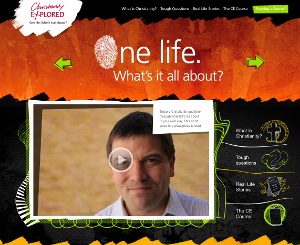
www.christianityexplored.org has now had over 50,000 visitors since its launch last month. A great initial response which we're all very excited about and thankful to God for.
We're about to have a fun review/planning meeting about the site and would love your feedback on the site.
Do post a comment below as we read them all and want this great site to keep getting better and be more useful as time goes on.

Christianity Explored is an evangelistic Bible Study course with a difference. Fine-tuned by Rico Tice, minister for evangelism at All Souls Church in London, it uses Mark’s Gospel to explain the Christian gospel. It encourages the church to do evangelism as the church, and not merely as isolated individuals.
The materials for Christianity Explored come in an attractive package of DVDs with clear and well-produced study materials. Rico himself is a gifted communicator with a warm, gracious and infectious enthusiasm for the gospel and the church.
There are many reasons why Christianity Explored is such a helpful tool for our churches.
This kind of fellowship in evangelism stimulates our own people to search the Scriptures better themselves. It binds them together in real fellowship as they pray together, are nervous together, and as together they see God work. As the Lord draws people to himself through his Word, expectation is increased that, on an ongoing basis, the Lord will bring more people to himself. That in turn leads to greater expectation in prayer as we ask him to do just that. At least this was certainly our experience.
Christianity Explored is no more than a tool; but it is a fine tool. And since there is nothing in the world more important than exploring Christianity, it provides a most helpful way of doing just that.