2 Corinthians 4 v 16-18
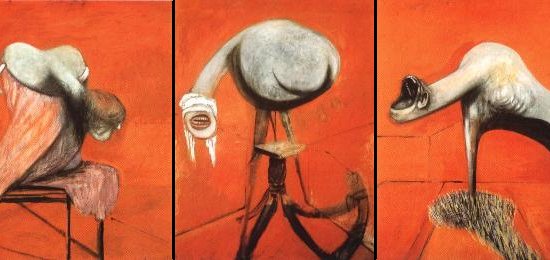
I blogged a few days ago about my visit to the Picasso exhibition that’s running at Tate Britain in London. Each room explored Picasso’s influence on a modern British artist, one of whom is Francis Bacon. I’m not a huge fan of Bacon’s work, so was scanning the paintings quite quickly – until I came across one that literally made me recoil with a shudder. I hated it. It was a triptych – the three paintings displayed side by side – each as horrible as the next.
Intrigued to know why I’d reacted so strongly, I went closer to read the blurb, and discovered that the three images were of people at the foot of the cross. That explained my revulsion. Bacon had cleverly taken the hate, spite, cruelty and self-righteousness of those who had crucified Jesus and were now watching, perhaps even gloating, as He died. “Yes”, I thought, “that’s the sick, evil rejection of God’s King”. And I felt the same revulsion for those wicked people that I had felt for the paintings.
And then I paused. Because it was my sin that held Jesus on the cross, just as much as theirs. The revulsion I felt is a slight glimpse of how we should respond to all sin – not just the obvious, the cruel, the violent – but all my “little” sins as well. The truth is that I have rejected God’s King every bit as much as those jeering onlookers. And it is only through His loving death for me that I now have the privilege of knowing Him as my Lord and Saviour. So now I’m really pleased that I hated Bacon’s work so much. Because through it I have been reminded of the blackness of my own heart, and the wonderful forgiveness made possible, and offered freely, by the one who died and rose again.

We're having a very busy week at the Christian Resources Exhibition so if you're having a busy time at the moment and struggling to fit everything in you'll find this weeks deal very useful! For the next week only you can get £4 off Tim Chester's book A Busy Christian's Guide To Busyness. We think it's great but don't just take our word for it....
'Tim Chester gets to the heart of why we are too busy, and unmasks the deceptions that drive our behaviours. This helpful book offers many practical time-saving tips and a biblical treatment of the busyness disease afflicting so many of us.'
- Paul Valler, former Finance and Operations Director, Hewlett-Packard Ltd
All you have to do is put in the code toobusy at the checkout.
Offer expires 18/05/2012

Anglican preacher barred from pulpit over opposition to gay marriage
Obama: Christ and the Golden Rule informed support of same-sex marriage
Evangelical voters: lift every voice
US Methodists uphold stance on same-sex relationships
It’s a safe bet that at a significant number of evangelical churches last Sunday, the service leader said something like:
“Now Sue’s going to come and read from the Bible, and then our pastor Steve is going to explain the passage to us.”
When I lead, that seems to be my default for explaining what a sermon is: I usually find myself saying that Steve (in our case) is “going to explain the passage to us”.
But I’m not sure that’s a good thing to say—certainly not a good thing to almost always say. A couple of reasons why:... continue reading
There’s a fascinating exhibition running at Tate Britain in London, called Picasso and Modern British Art. It traces the legacy and influence of Picasso on seven British artists including Ben Nicholson, Henry Moore and David Hockney. It’s well worth a visit. One room focuses on a visit Picasso made to London in 1919 to work on the scenery and costumes for Sergei Diaghilev’s ballet The Three-Cornered Hat. It reminded me of watching that same ballet, with Picasso’s scenery and costumes – though not in 1919. It was part of a programme of short ballets where the décor and/or costume designs were by well-known artists. My memory of The Three-Cornered Hat is lots of reeling around by a miller and his wife. But the ballet that really stuck in my mind was very different…... continue reading
Praise be to the God and Father of our Lord Jesus Christ, the Father of compassion and the God of all comfort, who comforts us in all our troubles, so that we can comfort those in any trouble with the comfort we ourselves have received from God. For just as the sufferings of Christ flow over into our lives, so also through Christ our comfort overflows.
2 Corinthians 1 v 3-5

We are more than homo sapiens (thinking beings). We are homo adorons (worshipping beings). It is vital then that we address more than the mind when we teach. Failure to do so means that we are not teaching the Bible. In this seminar - first given at the Bible-Centred Youthworker Conference earlier this year - Ian Fry explores how we can address the heart when we teach in church.

We always love meeting you so if you are coming to the Christian Resources Exhibition in Esher, Surrey next week then do please drop by the stand and say "hello". It would be great to hear how you are finding the resources we produce and to talk to you about some of the things we have coming up in the future ... And, of course, there will be some great deals! You'll be able to find us on stands E53-55 in the Esher Hall.
And, if you enjoy the kinds of ministry topics we blog about, you might like to come to one or more of the seminars we are running:
We look forward to seeing you there!