It’s not just a job for the professionals. We all have a role to play. There are hurt people in every congregation and we are all called to roll up our sleeves and get involved in spurring them on (Hebrews 10:24).
But pastoral care is not a simple task. It’s hard to speak the truth in love. And, as I was reflecting with a seminar group this weekend, we all too often let our desire to be encouraging overtake our need to be Christ-like and end up saying things that have the potential to be profoundly unhelpful.
What things? Well, the list is large and at first glance fairly innocuous but here are the big 3 phrases that we think should rarely, if ever, pass our lips and the reasons why they really don’t help.... continue reading
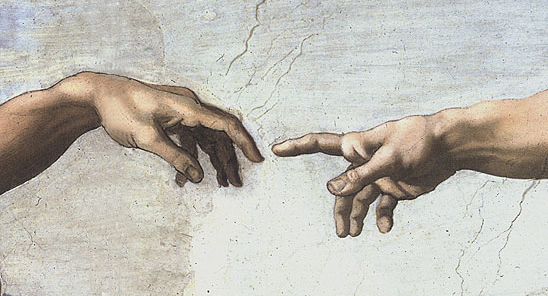
I’m used to being the centre of attention on the bus. I guess it’s the huge, metallic silver cello case on my back. Some people stare or laugh. Others ask what it is. And there’s the regular wisecrack: “I bet you wish you’d chosen the piccolo instead”. But yesterday I lost everyone’s attention. Why? Because a man got on carrying a huge, 5ft by 4ft picture of the Michelangelo image of the finger of God. The bus was full of the usual crowd of elderly shoppers, mums with toddlers, and students who’d just woken up. Every one of them riveted by the man and his picture. Clearly a silver cello can’t compete with a piece of the Sistine Chapel! But it did get me pondering…
Up until that moment, I suspect I was the only one on the bus who was thinking about God. But suddenly He was thrust into view – at least for those who recognised the picture. I’d love to tell you I used this the way Paul used the altar to an unknown God (Acts 17v23). “You see this painting of God’s finger? Let me tell you about the whole of God, and how you can know Him.” But I hesitated too long – and the man got off the bus and into the station, presumably to astound a lot of people on a train as well. So I fluffed my chance. But I’m praying that God will use the incident anyway. That someone from that bus will continue to think, or maybe even say “Guess what I saw on the bus” to a Christian with more courage than me. Because, while a giant finger on a bus is pretty memorable, it’s nothing at all alongside the incomparable riches of our Lord God.
Now there is in store for me the crown of righteousness, which the Lord, the righteous Judge, will award to me on that day—and not only to me, but also to all who have longed for his appearing. (2 Timothy 4 v 8)
Rather than competing for a gold medal, the athletes of Paul's day competed for a laurel crown. It is the heavenly crown that makes all the pain and sacrifice worth it for the Christian—our glorious future, which makes any pain in the present more than worthwhile. In the Olympics, one person gets the gold medal: in God's family, everyone who trusts and loves Jesus, longing for His return, will receive the crown of righteousness.

As I sat listening to the sermon at church last Sunday morning, I was struck by a big division. Some folk were scribbling earnestly in notebooks as the end of 2 Corinthians was unfolded for us. Others were just sat listening.
I've heard regular encouragements from the pulpit over the years, many suggesting that note-taking is a sign of real "keen-ness" as a Christian. And certainly there are some things to commend it:
The case against
But there is also a strong case against taking notes. Just because you are taking notes doesn't mean you are concentrating. You can be just as distracted from thinking about the meat of the message while scribbling as not.
Our media-driven generation has an uncomfortable disconnect between the way they use information and the age old biblical task of public preaching. Younger people in particular have a different relationship with information because of the way they access it. Lumps of facts and statistics are available at a click. Most of our young know how to get information, but are less sure how it should be processed. Hearing a sermon is not primarily about accumulating information, or about admiring the artfully alliterative point structure.
(Some people at church were even tapping away at their smartphones, raising the deep suspicion that they were not note-taking at all, but texting their friends about where to hook up for lunch, or trying to get to level 129 on Gemquest.)
And the anti-note brigade have some heavyweights on their side: Jonathan Edwards and Martyn Lloyd-Jones to name two.
Edwards said:
“The main benefit that is obtained by preaching is by impression made upon the mind in the time of it, and not by the effect that arises afterwards by a remembrance of what was delivered” (quoted in The Salvation of Souls, eds. Richard Bailey and Gregory Wills, 11).
Lloyd-Jones followed Edwards noting:
“The first and primary object of preaching is not only to give information. It is, as Edwards says, to produce an impression. It is the impression at the time that matters, even more than what you can remember subsequently … It is not primarily to impart information; and while you are writing your notes you may be missing something of the impact of the Spirit.”
And I certainly relate to that. I am not generally a note taker, because I find it easier to think about what is being said without the encumbrance of pen, paper or tablet. Although I have been known to reach for them if something is particularly noteworthy.
Are you a note taker or not? We'd love to hear the reasons why you do or don't.

Real Men is the next book in the One 2 One series. It's designed for an older christian to do with a teenage boy. It gets to the heart of what it means to be a man of God. So if there are boys in your youth group or church who need discipling get 2 copies with this great offer and you can go through it together!
Use the code: realmen at checkout to get 50% off! Offer expires at midnight on 04/03/2012

For many, exams are just around the corner and that can lead to a period of stress and, as time gets pressed, daily time with God can easily get pushed out. Don't Panic has daily Bible studies to help teenagers through the difficult time as well as helpful articles that cover topics like dealing with stress.
We're also offering 25% off ALL the Engage issues (for ages 14-18) and the Discover April-June edition (for 11-13 year olds). They get to the heart of Bible passages with practical applications for daily life.
Use the code: youth at the checkout to make the most of this offer. (Offer expires 09/03/2012)
Come back in a few hours for an offer on a brilliant new resource for teenage boys.........
Being a bombardier can be a useful tactic when trying to encourage children and young people to read their Bibles. Try lots of different things. Bombard them with different ideas to help them get stuck into God’s Word.
All Scripture is God-breathed and is useful for teaching, rebuking, correcting and training in righteousness, so that the man of God may be thoroughly equipped for every good work. (2 Timothy 3 v 16-17)
We want to see children and young people training in righteousness, so that they’re fully equipped to serve God. For that training, they need to be studying, learning from and memorising God’s Word. So we need to try every method at our disposal to encourage them to do that. Be a bombardier. Carpet bomb them with the Bible!... continue reading

Academics, some based in the UK, have argued it is not morally wrong to kill newborn babies if they are disabled. Here’s a chilling line from the Guardian’s report—it’s worth quoting the whole paragraph:
“What they preferred to call "after-birth abortion" rather than infanticide should be allowed not only for babies with abnormalities, such as Down's syndrome, which had not been detected during the pregnancy, but also newborns whose parents would have been granted an abortion because they felt they could not psychologically or materially cope with a child.”
We want to say that they are wrong...
But it is worth noting that, within the ethical framework most people in the UK operate, they are, logically, being consistent (please don't panic - bear with me…).
They argue that a baby is a non-person because they have no sense of their own existence, or of the fact that their existence is valuable. “The moral status of the individual killed is comparable with that of a fetus”. And it’s that sentence that is going to be a problem for people who don’t think abortion is wrong—so it’s that sentence which perhaps helps us to talk to friends about this issue.
In terms of value, there’s no intrinsic difference between a baby in the womb and a baby in the cradle. If one isn’t a person, neither is the other. If I say abortion is morally justifiable, I can’t really oppose infanticide (though these academics prefer to call it “after-birth abortion”). If, on the other hand, I understand that humans, made in God’s image (Genesis 1 v 26-28), have intrinsic value as His image-bearers (whether or not they have a sense of this great value), then I will oppose infanticide. And so I will oppose abortion as well.
Sadly, though not surprisingly, their views have led to threats being made against them—and that’s what some newspapers led with, rather than the substance of their argument. But justice is not ours to mete out, however horrific the opinion or the action: “’I will repay,’ says the Lord” (Romans 12 v 19). Our part is to love those who hate God and His standards—to pray for them and seek to tell them of judgment to come and forgiveness to enjoy. Wouldn’t it be great if their inboxes were filled up with assurances that they are being prayed for?