Tim Thornborough writes about keeping an eye on the clock over on his blog about leading a home group.
The study is flowing, the conversation is sharp, funny and moving by turn.
Someone raises an interesting question that everyone wants to comment on. Someone shares a deeply moving need that everyone wants to pray for.
You look at your watch, and it's 10.45.
"Whoa!" you cry, "time these little piggies were all tucked up in bed for the night." Some members shoot out of their seats and head straight for the door. Others linger in the hallway talking by the open door. You stifle a yawn, close the door and switch on the TV to wind down before you go to bed. The light doesn't go off until 12.45.
Sound familiar?
Time can just rush by at a homegroup when things are going well, when enthusiasm and interest seem to be sky high. But did you notice the warning signs in the little scenario above? "Some members shoot out of their seats and head straight for the door."
Before you read on, just pause for a moment and consider what the typical timings for your group meeting might be.... continue reading
This is an excellent testimony from our friends at Hill City Church, Wales.
"People used to think of me as Jim the Marine - it gave me that sense of recognition. And yet... there was something still missing."
James Richards talks about his experience serving with the Royal Marines, and his search for belonging in the battle of life.
Just laying out some Explore notes on 2 Timothy by David Sprouse, and thought this comment was a corker:
"It is a wonderful, as well as a sobering, fact that unlike any other book in the world, every time the Bible is read the author is present. And it is what He thinks that counts."
The debate on euthanasia is not going to go away. We’ve blogged on how we approach the issue ourselves, as Christians: and Dr Jason Roach guest-blogged a medic’s perspective.
But what about the question asked by a friend over a coffee at work, or on the way home from football, or at the school gate?
Here, for what it’s worth, is what we think we might say:

The media furore over euthanasia during the last few days has made one thing abundantly clear. Sir Terry Pratchett’s documentary on assisted dying only showed us one side of the debate.
Both disability groups and Christian ones declared that other views needed to be heard. I have to agree. My medical background and Christian convictions both push me to think about the other side of the story.
A key question for me is: “How does a change in law affect the most weak and vulnerable?”
My medical oaths tell me to do no harm. My Christian values tell me to “help the weak” (1 Thessalonians 5 v 14).
And my experience tells me that hard cases, like the ones that make it onto TV documentaries, make bad law.
Two examples illustrate the point. First, what starts as a right to die sometimes seems to turn into a duty to die. For example in Oregon, where euthanasia is legal, the percentage of people taking their lives who felt a burden on their families rose 50% in three years between 1998 and 2000. Disability campaigners are rightly concerned that the most weak may begin to feel they are obligated to end their life.
Secondly, such legislation would be intended to authorise people dying because some thought it was right; but it might lead to people being killed when we would all agree it was wrong.
I remember only too well reading the case of Philip Sutorius, a GP who helped an 86 year old woman to die. He said that she was suffering “unbearably”. His reasons? She had said that she was obsessed with getting older, and thought her existence was hopeless.
I wonder if, just like traffic lights rightly limit our freedom to protect other drivers, so keeping the law as it is limits our freedoms for the benefit of all.
I wonder, too, if this whole debate distracts from the great work of the hospice movement. Dame Cicely Saunders, a Christian woman, set up St Christopher’s Hospice to give weak and vulnerable patients the care, pain relief and comfort that deserve. She recognised that for the Christian our dignity isn’t conditional on our productivity, but intrinsic to our humanity.
Perhaps our “Big Society” would do well to champion those hard-working servants in hospice care. They have certainly taught me over the years to work hard to show sick people the respect that society so often seems to decide in advance that they cannot have.
Jason is a vicar and a doctor with a particular interest in medical ethics and has worked for the British Medical Journal.

And when you pray, do not be like the hypocrites, for they love to pray standing in the synagogues and on the street corners to be seen by others. Truly I tell you, they have received their reward in full. But when you pray, go into your room, close the door and pray to your Father, who is unseen. Then your Father, who sees what is done in secret, will reward you. And when you pray, do not keep on babbling like pagans, for they think they will be heard because of their many words. Do not be like them, for your Father knows what you need before you ask him.
Pic from http://web.me.com/saamvisual/epiloguetv/

Whatever your views on using the “alternative vote” system to elect our members of parliament*, it won’t have taken you long on the 5th to have made your mark. The voting slip I was handed was a tiny piece of paper with just two sentences and two boxes. I don’t think I’ve ever been so quickly in and out of a voting booth. But it struck me afterwards that as Christians we’re all in favour of alternative voting. Not as a political statement, but what John Stott calls Christian counter-culture. We believe in something most people think is nonsense. In living for Christ, we have a way of life that runs counter to the culture around us. And we stand up and are counted as followers of a leader far less popular than Nick Clegg.
For the message of the cross is foolishness to those who are perishing, but to us who are being saved it is the power of God. For it is written:
“I will destroy the wisdom of the wise;
the intelligence of the intelligent I will frustrate.”
Where is the wise man? Where is the scholar? Where is the philosopher of this age? Has not God made foolish the wisdom of the world? For since in the wisdom of God the world through its wisdom did not know him, God was pleased through the foolishness of what was preached to save those who believe. Jews demand miraculous signs and Greeks look for wisdom, but we preach Christ crucified: a stumbling block to Jews and foolishness to Gentiles, but to those whom God has called, both Jews and Greeks, Christ the power of God and the wisdom of God. For the foolishness of God is wiser than man’s wisdom, and the weakness of God is stronger than man’s strength. (1 Corinthians 1 v 18-25).
There’s one other way in which a vote for Christ is “alternative”. Who we choose in a polling booth is confidential – but our allegiance to Christ must not be. We are all called to be witnesses to Him, and the grace we have received in His name. Some of you reading this are in full-time Christian work like me. I’ve often thought that’s a great advantage in battling our nervous tendencies to keep quiet about our faith when talking to friends and neighbours. After all, they already know we do some strange religious job – so we might as well take advantage of that to reach out with the gospel message whenever we can!
*Britain recently held a national referendum do decide on whether it should reform it's system from "first past the post" to an "alternative vote". The decision was not to change.
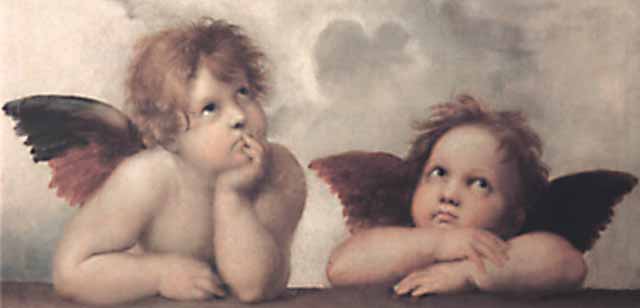
It's sometimes quite weird working in publishing. Just as the temperatures soar, and everyone is walking round in shorts eating ice creams, what are we doing? Writing stuff for Christmas!
Been working with GBCs outstanding childrens' editor Alison Mitchell on a new tract for Christmas for children. I stopped short at the sentence that said:
"A bunch of angels showed up and started singing praises to God"
What exactly is the group noun for angels? Alison originally had "troop" but thought it sounded a bit too militaristic. Not a bad idea, as the host of heaven sometimes acts as an army. But a brief brainstorm in the office came up with some other suggestions:
Any suggestions to help us out are warmly welcome...

Here in the UK, Sunday was census day - filling in the 32-page document cataloguing how our lives have changed since the last one ten years ago. There's been the usual furore about what questions that are and aren't asked. And a campaign by the British Humanist Association to get the non-religious to definitely state that they have no religious affiliation - see here for their reasoning. The government has defended its position on the questions we have been asked – and they’re in charge, so they had the last say.
Skip back 2000 years, to a different government. The rulers of the Roman Empire would have scoffed at the idea that they were being controlled by someone else. It was their idea to take a census - decreed by Caesar Augustus himself (Luke 2 v 1). They were in charge.
Or were they?
But you, Bethlehem Ephrathah, though you are small among the clans of Judah, out of you will come for me one who will be ruler over Israel…
(Micah 5 v 2)
The Lord had decreed that the Messiah would come from Bethlehem - over 700 years previously - and so the mighty Romans meekly did His bidding.

Further thoughts on the Home Group Leader blog