The anti-capitalists-on-the-steps-of-St-Paul’s saga rumbles on. Somewhere, in a parallel universe, a bunch of demonstrators recently turned up on the doorstep of a large church in central London. Here’s what happened next…
The people who worked for the church went out to chat to the protestors. They didn’t preach to them, they talked with them. They didn’t wear strange dresses, they wore normal clothes.
They pointed out to the protestors that other people wanted to get in to the church so that they could meet together and hear from God’s word together. They invited the protestors to join them, but asked if they would move their tents a little, to create a way of access into the building.
The protestors refused, so the church leaders hired a hall nearby to meet in, and closed the main building. The drawback of this was that tourists couldn’t look at the church (it was a famous one), but this didn’t matter much because (a) it wasn’t the main purpose of the building anyway and (b) the church leaders never charged anyone to look in the building anyway.
They continued to talk to the protestors. They made three main points:
The church showed its unity. And the church leaders made sure that whenever they spoke to the media, they mentioned in every sentence the name of Jesus, and what He had come to do—to rescue us not from material poverty, but from spiritual poverty.
Mind you, in this parallel universe:
Now back to the real world

Being good reformed Christians, who always read a Bible text in its context, perhaps a bit of context will help us treat tonight's "celebrations" a little differently.
Yes, tonight is Halloween, when children dress up and go door to door in search of a free sugar rush. But it is also a night of enormous opportunity, because it is also:
Reformation night!
October 31st was the day that Luther posted his famous 95 theses to the door of Wittenburg cathedral. An act which sparked the reformation and a return to the centrality of the Bible to the life and thinking of the church. No doubt he did it on that day because it was the eve of All Hallows day (Nov 1) with All Soul's day hot on its heels (Nov 2). Both days in the Catholic calendar when prayers for the dead, and the worshipping of saints was at its height. It was a night of protest for the Bible over tradition.
Suggestion: Why not nail your own theses to the door tonight in celebration, so that you can have the chance to share the Gospel message to your nocturnal visitors. John 8 v 12 might be a good place to start. As you kindly welcome your visitors and offer them a gift, read out the text to them, and tell them that there is now no fear of death and evil - because our saviour has already won over all of them when he died and rose again.
Jesus said: I am the light of the world, whoever follows me will never walk in darkness, but will have the light of life.
The question in the office/at the schoolgate/in the pub comes: Do you really believe in a God who told Israel to wipe out the Canaanites?
And you take a deep breath, offer up a silent and very heartfelt prayer, and open you mouth…

Which “side” do you take over the Dale Farm evictions?
Is it Christian to insist that the law is applied, that people are treated fairly and so punished when they break it, that lawbreakers shouldn’t get ahead of lawkeepers? Or is it Christian to ask for compassion on the travellers, who are staying true to their own culture and way of life, and who have built their lives on that site and in that area?
Watching the struggle on the news, and the evictions that were inevitable once the bailiffs had moved in, brings to life the shock of the parable of the tenants (or maybe we should call it the parable of the eviction) Jesus told in Mark 12 v 1-12.
And it brings home the shock that the tenants facing eviction are us.
Ultimately, we’re all illegal squatters, living in a world that isn’t ours but refusing to pay our dues to the owner. And we’re all facing certain eviction.
So far, so “kick out the travellers”.
But there’s a greater shock in Jesus’ parable even than the forcible eviction and death of the tenants. “He will … give the vineyard to others” (v 9). Who are the “others” who are given the world to live in? Not the deserving, but the undeserving. Not those who never kicked out the landlord’s son, but those who realized their mistake and asked for forgiveness.
That’s grace. That’s like Essex Council winning all the legal battles, proving the land was theirs and the travellers had no right to be there, preparing the bailiffs to move in with overwhelming force… and then walking in with the deeds to the land and saying to those living there illegally: “Here you are. It’s yours”.
I’m torn between the impulse for the law to have its say and be applied, and for compassion to be extended to the travellers. And I think that’s probably the Christian way to look at it. God is a God of total, unremitting justice; He’s also a God of amazing, undeserving grace. It’s right for us to long for justice; it’s right for us to long for grace; it’s wonderful that in Jesus Christ, the Son who was evicted in our place, we find both justice and grace.

Sometimes groups of Christians get things spectacularly wrong.
With the persistence of sin in the lives of believers (1 John 1:8) and the reality of false teachers in the church (2 Peter 2:1-3) this should not be a surprise. But it should be a cause of great sadness. And a massive spur to prayer. So with that in mind it’s good to encourage one another to be interceding for the church in Zimbabwe.
The Anglican Church there is in turmoil. A reasonable desire to be involved in politics has been distorted out of all proportion with bishops using governmental alliances to further their own ends and destroy the ministries of their rivals. Clergy have been evicted. Orphanages left with few staff. Congregations put at physical and spiritual risk.
Of course, amid all this there are good and godly pastors seeking to serve the Lord in Spirit and in truth.
The plight of the Anglican Church in Zimbabwe has been highlighted this week because Archbishop Rowan Williams is soon to visit there as part of his trip round central Africa. So why not use this increased publicity to encourage yourself and others in your congregation to pray?
It would be fantastic if Christians around the globe could join together and ask the Lord to:
It’s an inescapable fact that men and women are different.
It’s not that men are from Mars and women are from Venus – we’re all from planet earth and need to accept that fact.
Nor is it that girls are full or sugar and spice and all things nice and boys obsessed with slugs and snails – we’re all sinners and there’s no escaping that.
But we are created to complement one another (Genesis 2:20-24). To be both diverse as well as similar. And that means to a certain extent we learn differently and serve differently.
This has implications for preaching. It doesn’t change the gospel but it does mean that if sermons are to inspire, instruct and equip women then some careful thought needs to be given to how preachers communicate and apply God’s precious word.
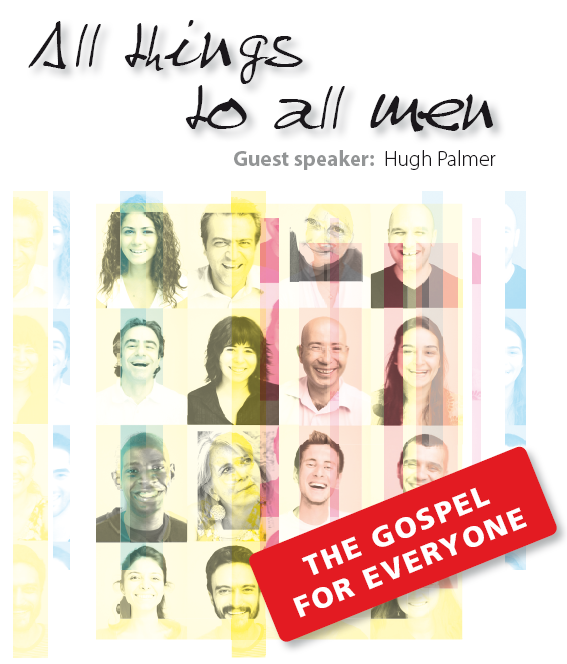
And this is one of the topics that are going to be considered at next week’s Evangelists' conferences. If you would like to explore this important area, there are still tickets available at both the London and Leyland venues. So why not come and join the conversation …? Or if you can’t make it to the event, check back here to read about some of the things we discussed.
|
Steve Jobs founder of Apple Computer, technological visionary and business genius and who died today. Apple products are owned by perhaps 300 million people worldwide. From his commencement speech at Stanford University 2005: "Remembering that I'll be dead soon is the most important tool I've ever encountered to help me make the big choices in life. Because almost everything - all external expectations, all pride, all fear of embarrassment or failure - these things just fall away in the face of death, leaving only what is truly important. Remembering that you are going to die is the best way I know to avoid the trap of thinking you have something to lose. You are already naked. There is no reason not to follow your heart.'' "Your time is limited, so don't waste it living someone else's life. Don't be trapped by dogma - which is living with the results of other people's thinking. Don't let the noise of others' opinions drown out your own inner voice.'' "Stay hungry, stay foolish." |
The Apostle Paul, theological visionary and passionate preacher who died, probably executed, sometime in the 1st Century. The faith he sought to bring to the non-Jewish world is adhered to by almost a third of the world's population - over 2 billion people. From the Letter to the Philippians For his sake I have suffered the loss of all things and count them as rubbish, in order that I may gain Christ and be found in him, not having a righteousness of my own that comes from the law, but that which comes through faith in Christ, the righteousness from God that depends on faith—that I may know him and the power of his resurrection, and may share his sufferings, becoming like him in his death. (3 v 10-11) "For me to live is Christ to die is gain" (1 v 21) "But one thing I do: forgetting what lies behind and straining forward to what lies ahead, I press on toward the goal for the prize of the upward call of God in Christ Jesus." (3 v 13-14) |
At the church I go to, some people shriek and shout their way through the songs. Others shout out things or snort loudly during the sermon. Still others need some restraint to stop them lashing out at others.
No, it's not the latest brand of "spiritual phenomena" that has hit South West London. It's just that we decided many years ago as a church that we needed to integrate people who live with profound learning disabilities into our church life. So at the youth group, in the children's groups and in the main meetings we have a sprinkling of folk with Downs Syndrome and cerebral palsy who take part in our regular worship. While there have been challenges, I have to confess that this has been a great choice for us all, and for the families who are caring for them.
But it raises an important theological question. Of course our Christian response to learning disability is to simply show love and compassion for their physical and emotional wellbeing, and for the families that are often under great stress. But how should we think about their spiritual needs? How should we explain the Gospel to them and encourage a response in the way we would any other?
I admit to confusion on the issue, which is why I am looking forward to next weeks' Evangelists' conferences, where one of the seminars is about sharing the Gospel with people with learning disabilities. Tony Phelps Jones from Prospects will be helping us think through some big issues.
If this is an issue of concern to you too, then do join us for what promises to be a stimulating and insightful day.
Book for the conference here.
And if you really can't get there do check this blog in the coming weeks for some great tips from the other excellent seminars being run.

22% of people in the UK live in an income poor household.
In a way, that’s a shocking statistic for a supposedly wealthy and developed country. But Christians shouldn’t be that surprised—after all, Jesus Himself reminded us of the reality that there will always be “the poor” (John 12 v 8). And the Bible commands us to do something about that—to provide for those who are struggling (Leviticus 25 v 34-36).
That’s a statistic, a reality and a command one church in Speke, Liverpool—one of the most deprived areas of the UK—is taking seriously. And the world is noticing. Have a read of this BBC article. And do pray for Steve Casey, the pastor, and his congregation as they seek to show and speak of Christ to some of that 22%.