
Our friends at Matthias Media are just about to launch a new free monthly digest for anyone involved in leading a home group.
Providing you with a regular diet of thought-provoking, Bible-centred articles, videos and book-recommendations, it looks as though this regular email service is going to be a great resource for anyone who wants to be better equipped to lead small groups.
If you are interested in signing up, please click here.

One of the greatest skills that you need to run a good Bible study is the instinct to craft good questions. You know what I mean...
But I've discovered over the years that, as the title suggests, often the best questions are not questions at all. Here's what I mean.
You've asked one of your finely crafted questions, and Janice, a young Christian who doesn't usually say very much, gives a hesitating answer, that shows she's on the right track. You can tell by the wrinkled forehead that she has got a lot more thoughts in her mind, but is unsure about her first answer, so has not said any more. So now is your chance to deploy the finest two words in Bible study history.
Are you ready for them?
Take a deep breath and repeat after me:
"Go on"
Say these two words out loud now - they will change the face of your home group forever!
"Go on"
These words say loads of things to Jittery Janice, or shrinking Stephen, or hesitant
Hannah, or timid Trevor. They tell them:
It's the equivalent of what some books call an "extending question" - but without the need to think of another question. With the right tone, or even prefacing it with "I think you're on the right track here, go on..." or "That's an interesting idea, go on...", you are encouraging them to speak so they can encourage everyone else.
Try it at your next home group meeting, and you will be astonished by the power of these two little words to transform your group.
But a word of caution. Don't tell your group to read this blog post. Word got back to a group I once ran about a training session I ran, where I talked about these magic words. From that time on - all they did when I said "Go On" was laugh at me...
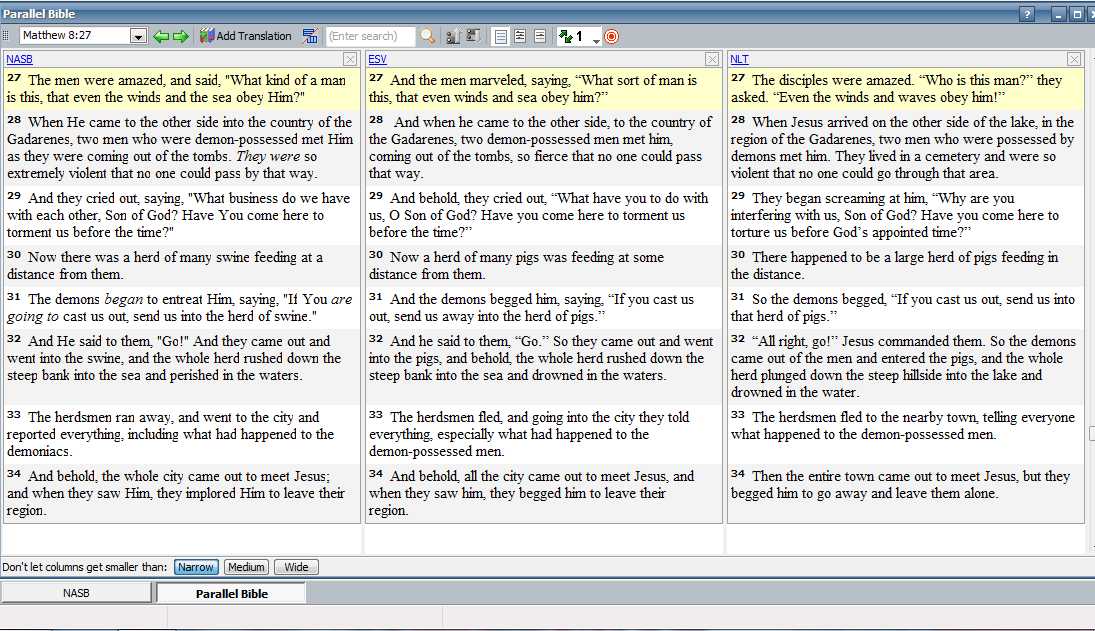
We were boldly plodding our way through Philippians and making great progress until we came to 3 v 3 -- and the evening descended into utter chaos. I won't cloud the issue with the rather complex questions that came out of that particular verse, but the problem was that we had too many Bible translations around the table for our own good. "He has an unhealthy craving for controversy and for quarrels about words" (1 Tim 6 v 4).
The blessing of translations
In the developed world, we are blessed with an extraordinary number of brilliant translations that help us get to the core of what the original text of the Bible is and means. We have literal word for word translations in the tradition of the AV, RV, RSV - the most modern being the New King James, and the English Standard Version.
And we have what are called the Dynamic Equivalence translations that try to translate phrase meanings, rather than words. The versions, like the now almost universal NIV and the New Living Translation (NLT) gain readability, at the expense of their making some decisions about interpretation for us.
And finally there are the paraphrases that do a lot of interpretation, and are more concerned with delivering the impact of the Bible using punchy language and modern idioms and expressions. Like The Message and before that the J B Phillips translation and the Living Bible (or the Living Libel as Ian Paisley used to call it).
Taken individually and together, these translations are a wonderful blessing to us. They help us see the richness and the nuances of the original Bible text. They give insight into what a difficult passage may be talking about, and, in the case of the Paraphrases, suggest brilliant ways of expressing these truths in pithy memorable ways, or even illustrating them with word pictures.
The curse of translations
But when you have a variety of translations around the table, especially when you are with young Christians, or even with those who are not yet Christian, they can be a curse. What could be a fantastic opportunity to talk about the challenge and nature of Christian discipleship, turns into a painful slog through the various semantic registers of the word "Confidence" - the whole study grinding to a halt as we run out of time, energy and willpower.
The tragedy is that the really brilliant things we could have been talking about have been hijacked by the fact that we have too many translations round the table. At their best, they can enlighten discussion. At their worst, they can completely derail it.
My solution? Simple.
Insist that there is a main translation that everyone works from in the group. Choose the translation you use, according to the lowest common denominator. And if "the least of these in the Kingdom" can only cope with the New International Reader's Version, or the excellent NCV, then that's the version to use. For most groups this will mean that you gravitate towards a well used standard version like the NIV.
Of course, in your preparation you will, as leader, make sure you have a look and a read of the passage in a variety of the above translations, so that you will be able to give a steer if a question is raised, without going off on a tangent.
And you won't ban people from using other translations. It's just that you will insist that there is one translation that you all default to. That way, you will spend your time talking about the substance of the passage, not nit picking over the details.
Do people think this is the right approach? What versions do you prefer to use, and why? Answers on a postcard (or alternatively, click the button below).

There are a number of manuals and training courses out there to help small group leaders get skilled up in doing what they do. I honestly think that this is the best available in a single, short, readable volume. In six short chapters Orlando Saer lays the foundations for shaping a home group into a group that will deliver real growth into Christian maturity.
So if you're new to home group leadership, then this little book will give you everything you need to know to get running on the right rails. And if you've been in leadership for years, then it might just be a useful corrective to some bad habits you've got into!
We're doing a special offer on this book at the moment, so follow the link to get a great book at a great price that could turn you into a great leader of a great group!
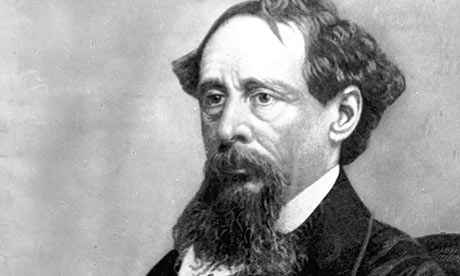
Today is the 200th anniversary of Charles Dickens' birth, and the screen and airwaves are alive with the characters and stories from his fertile imagination.
Dickens' portrayal of the brutality, fragility and hilarity of life in Victorian England is remarkable for its influence in social and political reform. For example, Marx and Engels were heavily influenced in their critique of the capitalist political system by their reading of Dickens. But it is probably his characters that most endure in our minds and culture - from the helpless victims of Oliver Twist, Pip and David Copperfield to the vicious perpetrators of cruelty like Wackford Squeers, Billy Sykes and Fagin.
While rarely explicit in Christian comment, Dickens' works contain many themes and illustrations that can be raided to illustrate and apply the Gospel. These themes from A Christmas Carol are worth exploring, while this story is helpful for explaining substitutionary atonement.
But how about this for a commemorative timely sermon outline that picks up on the themes of the week:
Our world is A Tale of Two Cities. Because, while we were created to know God, and enjoy him forever, we chose to reject God and so live in a Bleak House of our own making. All we can expect are Hard Times as we face the judgement of God. But God loves us and A Christmas Carol was sung when Jesus was born to rescue us. Because of Jesus' death and Resurrection (now there's an Oliver Twist), we can be born again into a living hope. The church may appear to be an Old Curiosity Shop, but it is filled with forgiven people with Great Expectations - eternal life with Christ.
Yes, it's cheesy, but a groan is worth a dozen laughs from the pulpit, as someone once said—though I'm pretty sure it wasn't Dickens.

I was looking at a verse of scripture with some friends at church recently that nailed an issue that I have struggled with for many years. It's an issue that lies at the very heart of our Christian lives, and something that is core to how you think about and run a home group. Are we tumblers (the thing for drinking out of that's often made from glass) - or are we tadpoles (the slightly icky things you find in the pond in spring that eventually turn into big icky things that you find in a pond). Or to put it less mysteriously more helpfully - How does God speak to us?
Here's the verse:
Think over what I say, for the Lord will give you understanding in everything (2 Timothy 2:7)
Here is the apostle Paul, writing to his young disciple Timothy, giving a simple instruction about how to read what he has just written. He says two things:
The meaning, and it's implications for us may not be immediately obvious. The Bible isn't like Cooking for Idiots - where we just have to slavishly follow every detail of the recipe to get a fragrant and edible end result. To do it's work in our minds and hearts, and from there into our lives, the words of scripture need to have the active engagement of our minds. We need to think about them. We need to meditate or ruminate on them. And in the context of our home groups, share our thoughts with each other on them.
Notice that this understanding is a gift. It is something that God gives us in his love and mercy. The Bible may be difficult in places and need thinking about, but that's not because God is trying to hide the truth from us. He wants to give us understanding. But notice also, that understanding is a promise. God promises to give us understanding when we engage with what he has said. The Lord will give you understanding.
So what's the stuff about the tableware and juvenile amphibians? Simply this. We need to hold the two halves of this verse together.
If it was all about point 1 - thinking about it - then we end up like tadpoles with massive heads and little bodies. It's all down to how clever and hard working you are. Put in the hours, learn the Greek, study the commentaries, scribble your mindmaps and eventually you gain understanding. But Paul tells us that this can never be the route to hearing God speak. Only to pride and false religion.
If it was all about point 2 - God giving us understanding - then all we would do is sit around like glass tumblers, doing nothing and waiting for God to fill the glass with his good things. It all seems terribly "spiritual" and humble, but it is just as bad a mistake as being a tadpole. In my experience, this approach leads to exactly the same place as the tadpoles - pride and false religion.
But as we hold them together we see the truth about how God speaks to us today. We listen to the authoritative, God-given teaching of the apostles in the Bible. We think about it. We discuss it, we study it, we get what help we need to from the clever people who write deep books. But we do our thinking humbly and prayerfully, knowing that only God himself can take these words on the page, and make them live in our minds and hearts, and show us how to live for Christ as a result.
Not tadpoles or tumblers, but people to whom God has given minds and Bibles and His Spirit, so that we can grow in our relationship with Him.

Welcome to the Homegroup leader's week on the Good Book Blog.
Over the next 6 days, we'll be posting something encouraging, stimulating, thought-provoking and (hopefully) insightful for helping you set your sights more clearly in home group leadership. But first of all, let's get back to basics: What is a home group actually for?
When you ask a random selection of small group leaders (which I did!), you get a huge range of responses:
But when you quiz people to find out how they actually spend their time in the small group, you often discover that many groups are given over to what we might call the human needs of the group, rather than on listening to God's word together. They eat, they talk they laugh (a lot!), they share needs, they enjoy each other's company, they feel supported, loved, affirmed, prayed for.
I try to point out (as gently as I'm able) that this surely has to be the tail wagging the dog. In Acts 2:42, we read a familiar description of what the first Christian community did when they met together: And they devoted themselves to the apostles’ teaching and fellowship, to the breaking of bread and the prayers.
They did a whole lot of stuff - but the first thing they did was devote themselves to the Apostles' teaching. All the other stuff they did sprang out of this fundamental activity - they listened to the authoritative word of God, delivered to them through his chosen representatives. And this is a pattern that persisted: In Colossians 3:16 we read: Let the word of Christ dwell in you richly, teaching and admonishing one another in all wisdom, singing psalms and hymns and spiritual songs, with thankfulness in your hearts to God.
The first Christians did many things when they met together, but the thing that was at the heart of each of them was that the Word of Christ was there - giving shape to their songs, their prayers - even the way the told each other off! People come to homegroups for many reasons. They may be lonely and need company; they may be hungry and need feeding; they may be discouraged or struggling in their lives, and need support.
But if you are the leader of a homegroup, you need to have firmly fixed in your mind that the way you will really meet their real needs is to let the Word of Christ from the Bible take centre stage in your time together. Bacon sandwiches help with the physical hunger, but the hunger in our hearts will only be fed by allowing the words of Jesus, and the Bible's witness to Jesus, to be the menu for the evening.